CCB Community Bank Bets on Relationships as It Grows in Northwest Florida
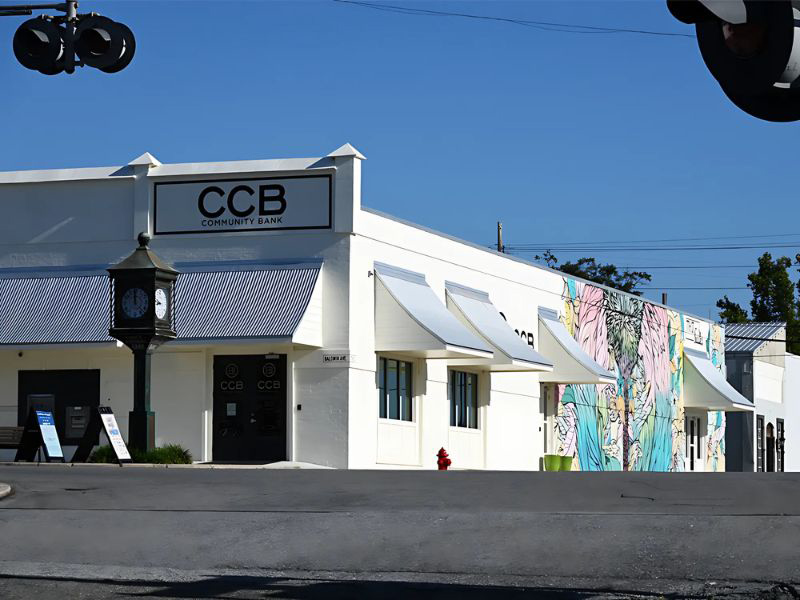
As CCB approaches 80 years in business and prepares for a new HWY 331 location in DeFuniak Springs, the regional community bank is holding onto an increasingly valuable idea: knowing the people it serves.
You can deposit a check from your phone. Transfer money at midnight. Pay a bill without ever walking into a bank. Modern banking has become remarkably convenient. But convenience doesn’t necessarily tell you who you’re banking with. Michelle Johnson can. Johnson has spent most of her career in banking, beginning with her first job straight out of high school. She spent 17 years working in South Walton before joining CCB Community Bank, and today she lives in DeFuniak Springs, where she has raised her children. When she talks about her customers, she doesn’t start with accounts, interest rates or technology. She talks about people.
“My customers are my family,” Johnson said.
She means the families whose children she has watched grow up. The businesses she has watched expand. The customers who graduate from high school, leave for college and sometimes come back home. That may be one of the simplest ways to understand what CCB Community Bank means when it calls itself a community bank. And as CCB approaches its 80th anniversary, that idea is being tested against a very modern question:
In a world where you can do almost everything with your bank from a phone, does it still matter who knows you on the other side of the desk?
CCB’s answer is yes. And the bank is putting that philosophy to work across the communities it serves.

A community bank is more than a branch
CCB Community Bank began in July 1947, when six local investors put $170,000 behind the idea of a hometown bank in Andalusia, Alabama. From the beginning, the bank says its goal was not simply to become profitable, but to build a successful institution that could reinvest in its communities. Over the decades, CCB expanded from its original Andalusia home into Opp, Alabama, and Northwest Florida, including Crestview, Niceville and DeFuniak Springs. Today, CCB has five locations serving communities in Covington County, Alabama, and Okaloosa and Walton counties in Northwest Florida.
For CCB, sommunity is also a business model. The bank says its employees are encouraged to volunteer locally, and its community involvement includes support for schools, athletics, charities, chambers of commerce, economic development organizations and community service agencies. But Johnson’s description is more personal. She lives where she works. She has raised her children in DeFuniak Springs. And when a customer comes through the door, the financial decision may be only one part of the conversation. That is important when the decision is a big one.
A first home. A new business. A growing business. A payroll system. A loan that could determine what comes next. “It’s important to just have dialogue,” Johnson said.

What happens when a banker looks at the whole picture?
For someone starting a business, walking into a bank for the first time can be intimidating.
There are financial statements, credit histories, projections and questions about how the business will make money. But Johnson describes CCB’s approach as less about looking at one number and more about understanding the whole picture. What is the person doing now? How does the industry work? Where does the business owner want to go? What does the financial picture look like? And what could help get them there? “If we start off small, we start off small,” Johnson said. “If we start off big, we start off big.” The important part, she said, is starting with a conversation.
CCB’s current business-lending information reflects that broader approach, offering financing for equipment, construction or improvements, working capital and revolving lines of credit, among other business needs. Its business checking materials also emphasize working with businesses as they grow. And then Johnson told a story that makes the philosophy easier to understand.
One local business. Five states later.
About two and a half years ago, Johnson said, two local businessmen came to her. They had decades of experience in their industries. They had a plan. And CCB extended its first credit to them. Today, she said, they have a new building, a warehouse facility and a business operating across five states.
CCB still banks the owners personally. It banks their children, too. Johnson is careful not to claim credit for what the business owners accomplished. “We were just a small piece in that,” she said.
But that small piece is the part she remembers. Because when a local business succeeds, the impact doesn’t necessarily stop with the person who owns it. It can mean new employees. More payroll.
A new building. More economic activity. A stronger community. “A small community business is success for the entire community,” Johnson said. That is perhaps the strongest argument for the community-bank model. The bank doesn’t build the business. The business owner does. But the relationship can give the owner another resource while they’re trying to build something that didn’t exist before.

CCB isn’t new to DeFuniak Springs. It’s growing with it.
CCB Community Bank has been part of DeFuniak Springs since 2022, operating from its current branch at 732 Baldwin Avenue. Now, the bank is preparing for a larger presence on Highway 331. CCB purchased roughly two and a half acres along HWY 331 South, just north of Bruce Avenue, where a new full-service branch is planned for 2027.
For Johnson and the five other employees working from the current location, the reason for the move is fairly straightforward: they’ve outgrown it. “We’re working in some tight corners right now with all six of us,” Johnson said.
The new DeFuniak Springs branch will add a drive-through and safe-deposit boxes while giving the growing team more room. Johnson said customers can expect the same people and personal service at the new location. The move comes as CCB prepares to celebrate its 80th anniversary in 2027, a milestone that puts the bank’s growth in perspective.
Banking has changed dramatically since CCB opened in 1947. CCB has changed with it, adding modern services including online and mobile banking, digital payments and other technology customers now expect. But when asked what has kept the bank relevant for nearly eight decades, Johnson didn’t point to technology.
“Just sticking to the basics,” she said. For Johnson, those basics are customer service, community and relationships. “The personal touch is something that CCB believes will never go away,” she said.
The part technology can’t replace
That philosophy becomes practical when customers need more than an app. Johnson points to something as ordinary, and potentially overwhelming, as changing banks. Moving years of automatic payments, direct deposits, payroll, debit cards and accounts can be enough to keep someone at the same institution simply because switching feels like too much work. “Changing banks is always scary,” Johnson said. At a community bank, she said, a customer can sit down with someone who will help work through that transition.
“You can change,” she said. “You don’t have to stay there forever.”
It’s a small example of the larger idea CCB is carrying into its next 80 years. The technology will continue to change. Communities will grow. Buildings will come and go. But Johnson hopes the relationship on the other side of the desk remains. “We are here for you,” she said.
And perhaps that’s the simplest definition of the kind of community banking CCB is betting on: know the people you serve, know the communities they call home, and be there when they’re ready to build what comes next.
Listen to the HWY 331 Podcast
Want to hear the conversation behind the story?
Michelle Johnson joins the HWY 331 Podcast to talk about her career in Northwest Florida banking, the local businesses she’s watched grow, CCB’s new HWY 331 location and why she believes knowing your banker still matters.
Listen to the HWY 331 Podcast with Michelle Johnson of CCB Community Bank.
HWY331.com Community Partners